
IoT Systems: Definition, Components, And Real Examples
Your smartphone adjusts your thermostat before you get home. A chair on your deck warms up the moment temperatures drop. Sensors in a warehouse track inventory in real time. These aren't isolated technologies, they're all examples of IoT systems working behind the scenes to make life more convenient, comfortable, and efficient.
At wrmth furniture, we build heated outdoor chairs that respond to their environment, keeping you warm on cool evenings without the hassle of patio heaters. Smart connectivity is central to how our furniture delivers consistent, personalized comfort. Understanding the technology that powers these experiences matters, whether you're a homeowner curious about smart products or a business exploring connected solutions for your patio or resort.
This article breaks down what IoT systems actually are, how their components work together, and where you'll find them in the real world. You'll get clear definitions without the jargon, practical examples across industries, and a solid foundation for understanding why this technology keeps showing up in everything from outdoor furniture to industrial equipment. By the end, you'll know exactly what makes an IoT system tick, and why it matters for products you use every day.
Why IoT systems matter
IoT systems transform how you interact with spaces, products, and services by connecting physical objects to digital intelligence. Traditional products require manual intervention every time you want to adjust settings, while connected devices anticipate your needs and respond automatically. This shift from reactive to proactive technology changes everything from how you manage your home to how businesses operate their facilities. The difference isn't just convenience, it's about making your environment work for you instead of the other way around.
Real-world efficiency and cost savings
You save time and money when systems optimize themselves based on actual usage patterns rather than guesswork. Smart thermostats reduce energy bills by learning your schedule and adjusting temperatures only when needed. Businesses running outdoor patios with heated furniture see lower operating costs because sensors activate heating elements only when temperatures drop and guests are present, eliminating waste from running equipment unnecessarily. Manufacturing facilities equipped with connected sensors cut maintenance expenses by predicting equipment failures before they happen, preventing costly downtime that can halt entire production lines.
Connected systems give you granular control over resources that traditional setups simply can't match. Warehouse operations that once required manual inventory counts now track stock levels automatically, reducing labor costs and improving accuracy. Hotels monitor room occupancy and climate in real time, adjusting heating and cooling only in occupied spaces rather than maintaining constant conditions throughout empty buildings. These efficiency gains compound over time, turning what seems like modest improvements into substantial operational advantages that directly impact your bottom line.
Better decisions through connected data
Data collection from IoT systems reveals patterns you'd never spot through casual observation or periodic checks. Your heated outdoor furniture doesn't just warm you up, it tracks usage patterns that show exactly when guests prefer outdoor spaces, how long they stay, and what temperature settings keep them comfortable. Restaurants use this information to optimize staffing levels during peak outdoor seating times, while resort managers adjust amenities based on actual guest behavior rather than assumptions.
When you base decisions on real-time data instead of estimates, you eliminate the guesswork that leads to wasted resources and missed opportunities.
Business intelligence from connected devices helps you spot trends before they become obvious problems or opportunities. Retail stores with sensor-equipped displays learn which product placements generate the most engagement, allowing them to adjust layouts dynamically. Property managers monitoring outdoor amenities see exactly which features drive tenant satisfaction, informing future investment decisions with concrete evidence rather than surveys or complaints. This continuous feedback loop means you're always working with current information instead of making choices based on outdated assumptions or incomplete pictures of how people actually use your spaces.
Enhanced comfort and personalization
Automated adjustments based on environmental conditions create experiences that feel intuitive rather than technological. You shouldn't need to check weather forecasts or fiddle with controls when you want to relax on your deck. Smart outdoor furniture detects temperature drops and responds instantly, maintaining your comfort without requiring any action on your part. Golf courses offering heated seating at tee boxes keep players comfortable during early morning rounds when temperatures haven't reached their daily peak, extending playable hours and improving the overall experience.
Personalization through IoT systems means products adapt to your preferences rather than forcing you to work within fixed parameters. Your heated chair remembers your favorite temperature settings and activates them automatically when you sit down. Hotels customize room environments for returning guests based on their previous stays, adjusting everything from climate to lighting before check-in. These tailored experiences don't require complicated setup or technical knowledge on your part, the system handles everything in the background while you simply enjoy consistent comfort that matches your expectations every single time.
IoT system components and architecture
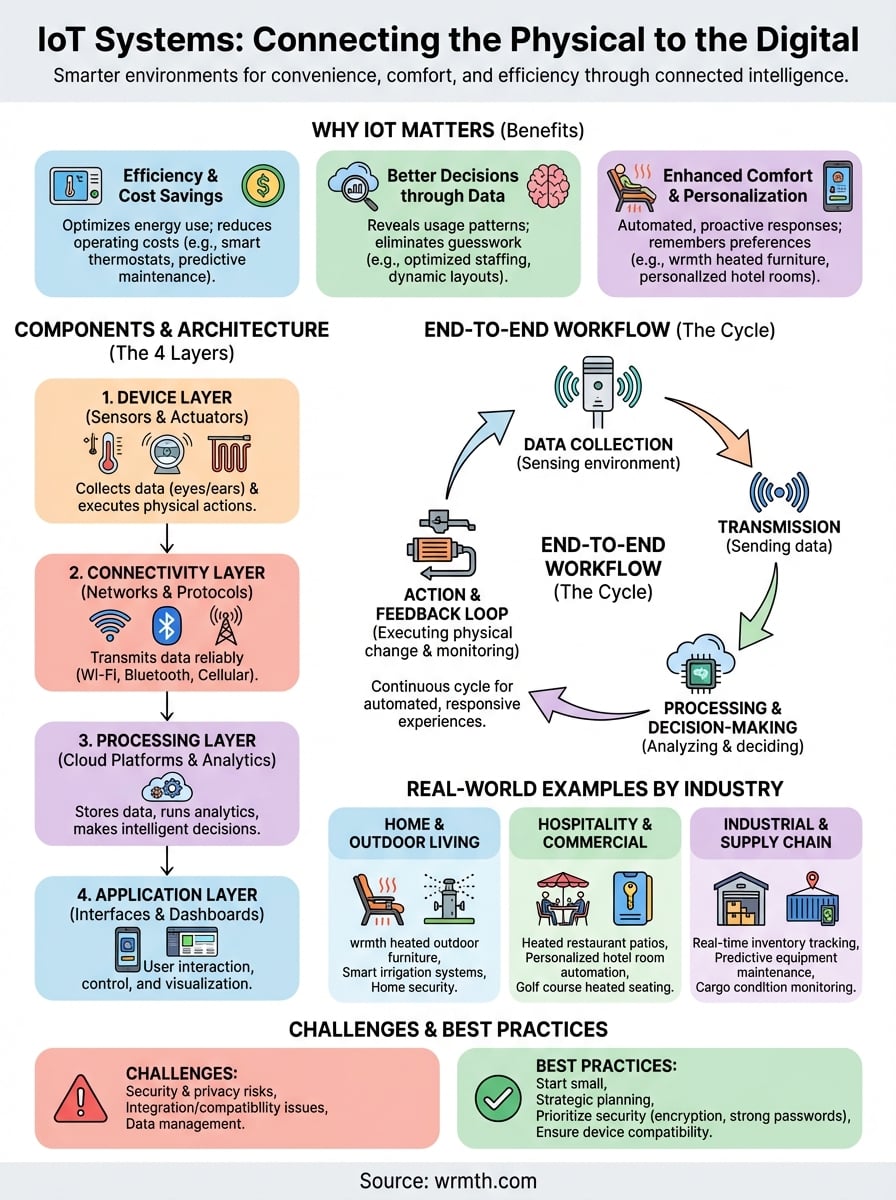
Every IoT system follows a basic structure that moves information from physical sensors to digital platforms and back again. You'll find four main layers working together: devices that collect data, networks that transmit it, platforms that process it, and applications that make it useful. Understanding this architecture helps you see why your heated outdoor furniture responds instantly to temperature changes or how a warehouse tracks thousands of items simultaneously without human intervention.
Device layer: sensors and actuators
Sensors form the eyes and ears of any IoT system, constantly monitoring conditions like temperature, motion, humidity, or pressure. Your heated chair contains temperature sensors that detect environmental changes, while motion sensors determine when someone sits down. These devices convert physical conditions into digital signals that other system components can understand and act upon. Actuators work in reverse, taking digital commands and creating physical actions. The heating elements in your furniture are actuators that respond to sensor data by generating warmth, just as smart locks respond to digital commands by physically opening or closing.
Devices need power sources and basic processing capabilities to function reliably. Battery-powered sensors in remote locations must balance data collection frequency with energy consumption, while permanently installed devices like heated furniture connect to standard electrical systems for consistent operation. Modern devices include edge computing capabilities that handle basic processing locally, filtering out unnecessary data before transmitting anything to central systems.
Connectivity layer: networks and protocols
Wireless networks like Wi-Fi, Bluetooth, and cellular connections carry data between devices and central platforms. Your outdoor furniture might use Wi-Fi connectivity to communicate with a mobile app, while industrial sensors in warehouses rely on dedicated networks that prioritize reliability over speed. The choice of connectivity depends on factors like range requirements, data volume, and power availability. Devices placed far from buildings need different network solutions than furniture positioned on your deck within range of your home router.
The connectivity layer determines how quickly your system responds to changing conditions and how reliably it maintains communication.
Protocols establish rules for how devices communicate, ensuring that sensors, networks, and platforms all speak the same language. Standards like MQTT and HTTP define message formats and transmission methods, while security protocols protect your data during transmission. You don't need to understand technical specifications, but knowing these standards exist helps you evaluate whether different smart products in your home or business can work together seamlessly.
Processing and cloud platforms
Cloud platforms receive data from connected devices, store it securely, and run analytics that identify patterns or trigger automated responses. When your heated furniture detects dropping temperatures, the platform processes this information alongside user preferences and usage history to determine the optimal heating level. Platforms also manage device coordination, ensuring that multiple chairs or other connected products work together smoothly without conflicts or redundant actions.
Analytics engines transform raw sensor data into actionable insights. Your furniture's platform tracks usage patterns over time, learning when you typically use outdoor spaces and what temperature settings keep you comfortable. Businesses running multiple locations use these platforms to compare performance metrics across different sites, identifying which outdoor amenities generate the most engagement and where operational improvements could increase efficiency.
How IoT systems work end to end
IoT systems follow a continuous cycle that starts with sensing your environment and ends with actions that improve your experience. The process happens automatically once you set up your devices, creating a seamless loop that responds to changing conditions without requiring constant attention. Understanding this end-to-end flow helps you see why connected furniture or smart building systems can anticipate your needs rather than just reacting when you push buttons or adjust manual controls.
Data collection and transmission
Sensors embedded in your devices continuously monitor specific conditions based on what they're designed to track. Your heated outdoor furniture measures ambient temperature, seat occupancy, and current heating levels multiple times per minute, creating a steady stream of environmental data. These measurements get converted into digital signals that travel through wireless networks to central processing systems. The transmission happens in milliseconds, so by the time temperature drops enough to affect your comfort, the system already knows and has started responding.
Network protocols ensure data reaches its destination reliably even when your Wi-Fi experiences brief interruptions. Devices store recent measurements locally and transmit them in batches if connectivity drops temporarily, preventing information gaps that could disrupt service. This redundancy means your heated chair keeps functioning properly even when network conditions aren't perfect, maintaining comfort without making you troubleshoot connection issues.
Processing and decision-making
Cloud platforms receive incoming data and compare it against preset rules and learned patterns to determine appropriate responses. When your furniture's sensors report dropping temperatures, the platform checks your usage history, current time, and manual override settings before deciding whether to activate heating elements. Processing engines run these calculations instantly, evaluating multiple factors simultaneously to make intelligent decisions that balance comfort with energy efficiency.
The intelligence in IoT systems comes from analyzing real-time data alongside historical patterns, not just reacting to individual measurements.
Action and feedback loop
Actuators receive commands from the processing layer and execute physical changes based on those decisions. Heating elements in your chair activate to specific temperature levels, adjusting their output intensity according to how much warmth you need. The system simultaneously monitors the results of its actions, creating a feedback loop where new sensor readings confirm whether the response achieved desired conditions or if additional adjustments are necessary.
Continuous monitoring means the system constantly refines its actions based on actual outcomes rather than assumptions. Your furniture doesn't just turn heat on and leave it running, it modulates power levels dynamically as conditions change throughout your evening outdoors.
Real IoT system examples by industry
IoT systems operate across virtually every sector, transforming how businesses deliver services and how you experience products in your daily life. These connected technologies solve specific problems in different industries, from extending your outdoor season at home to optimizing complex warehouse operations. Looking at real-world applications helps you understand the practical value these systems deliver beyond theoretical benefits or marketing promises.
Home and outdoor living
Heated outdoor furniture represents a direct application of IoT technology that extends your usable outdoor space beyond summer months. Your wrmth furniture uses temperature sensors and smart controls to maintain comfort automatically as evening temperatures drop, eliminating the need for bulky patio heaters that waste energy heating empty air. Smart irrigation systems in your yard monitor soil moisture levels and local weather forecasts, watering your lawn only when necessary rather than following fixed schedules that ignore actual conditions. Home security systems combine motion sensors, cameras, and smart locks to protect your property while letting you monitor and control access remotely through mobile apps.
Connected home products work together to create responsive environments that adjust to your needs without requiring constant manual adjustments.
Hospitality and commercial spaces
Restaurant patios equipped with heated seating extend their service seasons by keeping guests comfortable during cooler months, increasing revenue from outdoor dining areas that would otherwise sit empty. Hotels deploy room automation systems that adjust lighting, temperature, and entertainment based on guest preferences stored from previous visits, creating personalized experiences that improve satisfaction scores and encourage return bookings. Golf courses install heated seating at tee boxes and clubhouses, allowing play during early morning hours when temperatures haven't reached comfortable levels, maximizing course utilization throughout the day.
Industrial and supply chain
Warehouse management systems use sensor networks to track inventory locations and quantities in real time, reducing the labor costs associated with manual counts while improving accuracy. Manufacturing facilities monitor equipment performance through vibration sensors and temperature readings that predict maintenance needs before breakdowns occur, preventing costly production stoppages. Shipping companies attach GPS trackers and environmental sensors to cargo containers, monitoring location and conditions like temperature or humidity for sensitive products during transit, ensuring quality standards are maintained from departure to delivery.
IoT system challenges and best practices
Building and maintaining IoT systems involves navigating technical obstacles that can compromise performance, security, or user experience if you ignore them. Common challenges range from protecting sensitive data against cyber threats to ensuring different devices communicate properly across various platforms and manufacturers. You'll face these issues whether you're setting up heated outdoor furniture at home or deploying connected sensors across multiple business locations, making it critical to understand both the problems and proven solutions that prevent them.
Security and privacy concerns
Cybersecurity threats represent the most serious risk in IoT systems because connected devices create potential entry points for unauthorized access to your network. Weak passwords on smart furniture or cameras let attackers infiltrate your entire home system, potentially accessing personal information or controlling devices remotely. Data encryption during transmission and storage protects information from interception, while regular firmware updates patch vulnerabilities that hackers exploit. You should change default passwords immediately after installing any connected device and enable two-factor authentication wherever available, creating multiple barriers against unauthorized access.
Protecting your IoT system requires treating every connected device as a potential security risk that needs proper configuration and ongoing maintenance.
Privacy considerations extend beyond preventing breaches to controlling how manufacturers collect and use your data. Smart furniture tracking your usage patterns or cameras monitoring your property generate information that companies might share with third parties or use for purposes you didn't authorize. Reading privacy policies before purchasing connected products helps you understand what data gets collected and how it's used, while opting out of non-essential data sharing protects your information from unnecessary exposure.
Integration and compatibility issues
Device compatibility problems arise when products from different manufacturers use incompatible communication protocols or proprietary systems that don't work together. Your heated outdoor furniture might connect perfectly to your smartphone but fail to integrate with existing home automation platforms, forcing you to manage multiple separate apps instead of unified control. Choosing devices that support industry-standard protocols like Wi-Fi or Bluetooth increases the likelihood they'll work with your current setup, while researching platform compatibility before purchasing prevents frustrating discoveries after installation.
Best practices for implementation
Strategic planning before deploying iot systems saves you from costly mistakes and incomplete implementations. Start with clear goals about what you want your connected devices to accomplish, whether that's extending your outdoor season with heated furniture or monitoring equipment performance in commercial facilities. Testing devices in limited deployments before full-scale rollout helps identify problems in controlled environments where fixes are simpler and less disruptive than discovering issues after installing hundreds of sensors.
Next steps
You now understand how iot systems connect physical devices to digital intelligence, transforming everything from your outdoor furniture to industrial equipment. Start small with your IoT adoption rather than attempting complete overhauls. Pick one area where automated responses would solve a specific problem, whether that's extending your outdoor season or improving energy efficiency in your home or business.
Research compatible devices that work with your existing setup before making purchases. Read security guidelines carefully and enable protective features immediately after installation. Your success with connected technology depends on proper configuration from day one, not fixing problems after they compromise your system or expose your data.
Experience IoT technology firsthand through products that deliver immediate value. wrmth furniture demonstrates how smart outdoor heating extends your season automatically, keeping you comfortable without the hassle of traditional patio heaters. Join our Indiegogo campaign for early access to spring 2026 deliveries and see how connected furniture transforms your outdoor living space.