
How to Heat an Outdoor Patio: Options, Costs, and Safety
Your outdoor patio becomes unusable when temperatures drop. You invested in creating a beautiful space, but cooler evenings and shoulder seasons force you inside, leaving that deck or patio empty for months.
The good news is that heating your outdoor space is entirely possible. You can choose from several proven methods, from propane heaters to infrared units to heated furniture. Each option has different costs, coverage areas, and installation requirements. The right choice depends on your specific patio size, climate, budget, and how you use the space.
This guide walks you through the complete process of heating your outdoor patio. You will learn how to assess your space and utilities, compare heating options with real performance data, calculate upfront and ongoing costs, and install everything safely. By the end, you will know exactly which heating solution fits your needs and how to implement it properly. Whether you want to extend your patio season by a few weeks or use it year round, you will find the practical information you need to make it happen.
Prerequisites before you heat your patio
Before you select and install any heating system, you need to complete several practical checks. Understanding local regulations, electrical capacity, and gas line availability will save you time and prevent costly mistakes. These prerequisites determine which heating options will work for your specific situation and help you avoid code violations or unsafe installations.
Check local codes and permits
Your municipality likely has specific regulations for outdoor heating equipment. Contact your local building department to learn whether you need permits for permanent installations like natural gas lines, electrical circuits, or ceiling-mounted heaters. Most areas require permits for any new gas line work or electrical circuits rated above 20 amps.
Building codes exist to protect your safety and property value, so skipping this step creates liability.
Review your homeowner's association rules if applicable. Many HOAs restrict certain types of outdoor heaters or require architectural approval before installation. Check your homeowner's insurance policy as well, since some insurers have specific requirements for outdoor heating equipment. Document everything in writing before you purchase any equipment, and keep copies of all permits and approvals for future reference when learning how to heat outdoor patio spaces properly.
Step 1. Assess your patio, climate, and utilities
You must understand your specific outdoor space before selecting any heating equipment. This assessment determines which heating options will actually work for your situation and prevents expensive mistakes. Take measurements, check your existing utilities, and consider your local climate conditions to narrow down the practical choices.
Measure your patio dimensions and coverage needs
Calculate the total square footage of your patio by multiplying length times width. A standard 10×12 foot patio covers 120 square feet, while a larger 15×20 space spans 300 square feet. Write down these numbers because heating capacity is rated in BTUs per square foot, and you will need this measurement when comparing heater specifications.
Identify which zones require heat most. You probably do not need to heat the entire patio uniformly. Mark the seating areas, dining spaces, and high traffic zones where people actually spend time. Most homeowners heat only 60 to 70 percent of their total patio area, which significantly reduces equipment and operating costs.
Evaluate your climate and usage patterns
Your lowest typical temperature during intended use determines the minimum heating capacity you need. If you want to use your patio when outdoor temperatures drop to 40°F, you need different equipment than someone targeting 60°F evenings. Check historical weather data for your area to identify realistic temperature ranges during spring, fall, and winter months.
Consider wind exposure and overhead coverage as well. Open patios with no roof or windbreak lose heat quickly and require 25 to 40 percent more heating capacity. Covered patios with partial walls retain warmth better and cost less to heat effectively.
Wind breaks, pergolas, and patio covers can reduce your heating requirements by up to 40 percent while making the space more comfortable.
Verify electrical and gas infrastructure
Locate your electrical panel and count available circuit breakers. Electric heaters typically require dedicated 20 to 30 amp circuits, and you need to confirm your panel has capacity before installation. Hire a licensed electrician to assess your system if you are unsure about available capacity or wire gauge requirements.
Check for existing natural gas lines near your patio if you are considering gas heaters. Running new gas lines costs $12 to $25 per linear foot installed, so proximity to existing service matters significantly. Propane becomes more practical when natural gas requires extensive trenching or when lines are more than 30 feet away.
Step 2. Compare heaters, fire pits, and heated seats
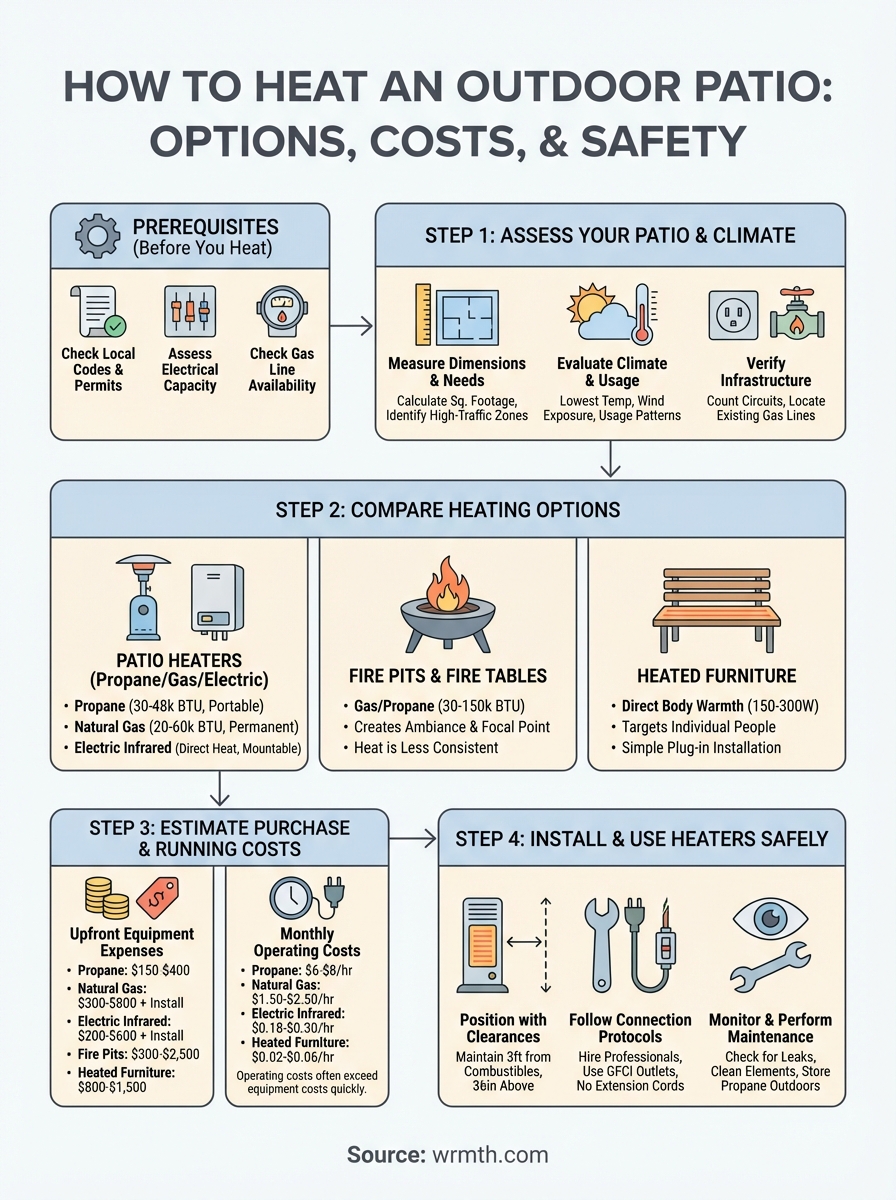
You have three main categories of heating solutions when deciding how to heat outdoor patio spaces: traditional heaters (propane, gas, electric), fire features, and heated furniture. Each category works differently, covers varying amounts of space, and suits different patio layouts and budgets. Understanding the specific performance characteristics of each option helps you select the right equipment for your situation.
Propane and natural gas patio heaters
Freestanding propane tower heaters produce 30,000 to 48,000 BTUs and heat a 15 to 20 foot diameter circle around the unit. You can move these heaters easily since they include wheels and use standard 20-pound propane tanks stored in the base. Expect 8 to 10 hours of operation per tank at full heat output. These units work best for open patios without overhead structures.
Natural gas heaters connect permanently to your gas line and eliminate the need to refill tanks. Wall-mounted and ceiling-mounted models produce 20,000 to 60,000 BTUs depending on size. Mount ceiling units at least 8 feet high and position them to radiate heat downward across seating areas. Wall-mounted versions require 18 to 24 inches of clearance from combustible materials and direct heat horizontally across your space.
Electric infrared heaters
Electric infrared models heat objects and people directly rather than warming the air around them. These heaters mount to walls, ceilings, or pergola structures and require dedicated 240-volt circuits for larger units. Output ranges from 1,500 watts (5,100 BTUs) for small units to 6,000 watts (20,500 BTUs) for high-capacity models. You need roughly 100 watts per square foot of coverage in mild climates or 150 watts per square foot in colder regions.
Installation costs run lower than gas lines since you only need electrical wiring, but operating costs depend on your electricity rates. Position infrared heaters 8 to 10 feet above the floor and angle them toward seating areas for maximum effectiveness. These units operate silently and turn on instantly without warmup time.
Fire pits and fire tables
Gas fire pits and fire tables produce 30,000 to 150,000 BTUs while creating a focal point for gatherings. You connect these features to natural gas or propane tanks, and they heat a 6 to 12 foot radius around the fire. Fire tables work well as centerpieces for seating arrangements, combining both heat and ambiance in a single unit.
Consider that fire features heat inconsistently, with one side of the seating area receiving more warmth than the other. You will need to rotate seating positions or supplement with additional heating if you want uniform coverage. Local regulations may restrict open flames in certain areas, so verify fire pit legality before purchasing.
Fire features excel at creating atmosphere but rarely provide enough consistent warmth to heat an entire patio effectively.
Heated outdoor furniture
Heated chairs and benches deliver warmth directly to your body rather than attempting to heat the surrounding air. These units integrate heating elements into the seat and backrest, using 150 to 300 watts of electricity per chair. You plug them into standard 120-volt outlets, making installation simple compared to other heating methods.
This approach works particularly well for small patios or when you only need to heat specific seating positions. Heated furniture uses significantly less energy than space heaters because it targets individual people rather than the entire area. You can place heated seats anywhere on your patio and move them as needed without electrical work or gas line installation.
Step 3. Estimate purchase and running costs
You need to calculate both upfront equipment expenses and ongoing operating costs to determine the true expense of heating your patio. Understanding these numbers helps you compare options accurately and choose a solution that fits your budget long term. Some heaters cost less initially but more to operate, while others require higher investment upfront but deliver lower monthly bills.
Calculate upfront equipment expenses
Propane tower heaters range from $150 to $400 for quality residential units with 40,000 to 48,000 BTU output. Natural gas installations cost more because you must add professional installation fees of $300 to $800 depending on distance from your existing gas line. Electric infrared heaters run $200 to $600 per unit, plus $150 to $400 for electrical circuit installation if you need new wiring.
Fire pits and fire tables vary widely based on size and construction quality, with prices from $300 for basic models to $2,500 for premium units. Heated furniture costs $800 to $1,500 per chair but requires no installation expenses beyond a standard electrical outlet. Add these installation costs to your equipment budget when comparing total upfront investment across different heating methods.
Determine monthly operating costs
Calculate operating expenses based on your expected usage hours per month and local fuel or electricity rates. A 48,000 BTU propane heater burns approximately 2 pounds of propane per hour, costing $6 to $8 per operating hour at current propane prices. Natural gas costs roughly $1.50 to $2.50 per hour for similar heat output, making it cheaper in areas with established gas service.
Electric heaters using 1,500 watts cost $0.18 to $0.30 per hour at typical residential electricity rates of 12 to 20 cents per kilowatt hour. Heated furniture draws only 150 to 300 watts per chair, costing $0.02 to $0.06 per hour when learning how to heat outdoor patio seating efficiently. Multiply your hourly rate by expected monthly usage hours to project actual operating expenses for each option.
Operating costs typically exceed equipment costs within the first heating season for gas and electric heaters, making efficiency crucial for long-term savings.
Step 4. Install and use heaters safely
Safety considerations determine where you can place heating equipment and how you operate it long term. Improper installation creates fire hazards, carbon monoxide risks, and potential injury from burns or tip-overs. Following manufacturer specifications and local codes protects both your property and the people using your heated patio space.
Position heaters with proper clearances
Place freestanding propane heaters at least 3 feet away from walls, railings, furniture, and any combustible materials. You must maintain a minimum 36-inch clearance above the heater to prevent fire risk from overhead structures like pergolas or awnings. Never position any heater near doorways, high-traffic areas, or locations where people could bump into hot surfaces accidentally.
Mount ceiling and wall units according to manufacturer specifications, typically 8 to 10 feet high for ceiling models and 6 to 8 feet high for wall-mounted heaters. Keep electrical heaters at least 18 inches from combustible materials and ensure natural gas units have proper ventilation to prevent carbon monoxide buildup in covered areas. Secure all mounted units to structural members, not just decorative trim or surface materials.
Improper clearances account for 60 percent of outdoor heater accidents, making correct positioning your most important safety measure.
Follow electrical and gas connection protocols
Hire licensed professionals for all natural gas line installations and dedicated electrical circuits. Gas connections require pressure testing, leak detection, and proper shutoff valve installation within code requirements. Electrical circuits need correct wire gauge, GFCI protection for outdoor outlets, and weatherproof enclosures rated for exterior use when learning how to heat outdoor patio spaces safely.
Never use extension cords with electric heaters rated above 1,500 watts. Plug heaters directly into properly grounded outlets with adequate amperage for the equipment load. Test GFCI outlets monthly by pressing the test button to verify proper function.
Monitor operation and perform regular maintenance
Check propane connections for leaks before each use by applying soapy water to fittings and watching for bubbles. Inspect gas hoses annually for cracks, wear, or damage and replace immediately if you find any issues. Clean heating elements and reflectors seasonally to maintain efficiency and prevent dust buildup that creates fire risk.
Store propane tanks upright in well-ventilated outdoor locations away from ignition sources and never inside enclosed spaces. Turn off all heaters when leaving the patio unattended and establish a regular shutdown routine that includes checking pilot lights and closing gas valves completely.
Final thoughts
You now understand how to heat outdoor patio spaces with the right equipment, costs, and safety measures. Traditional heaters work for large areas, but heated furniture delivers warmth directly to you while using less energy and requiring no installation. Consider heated outdoor chairs from Wrmth if you want personal warmth without the hassle of propane tanks, gas lines, or high electricity bills. Your patio season can extend year-round with the right heating approach.