
How to Achieve Thermal Comfort: Design and HVAC Strategies
You adjust the thermostat. Five minutes later someone changes it back. This cycle repeats all day. The truth is no single temperature setting satisfies everyone. People near windows feel cold drafts while those under vents get blasted with conditioned air. Traditional systems focus only on air temperature and ignore what actually makes people comfortable.
Real thermal comfort requires balancing six variables that affect how your body feels. Air temperature matters but so does humidity, radiant heat from surfaces, airflow, your activity level, and clothing. When you control these factors together you create comfortable spaces while using less energy.
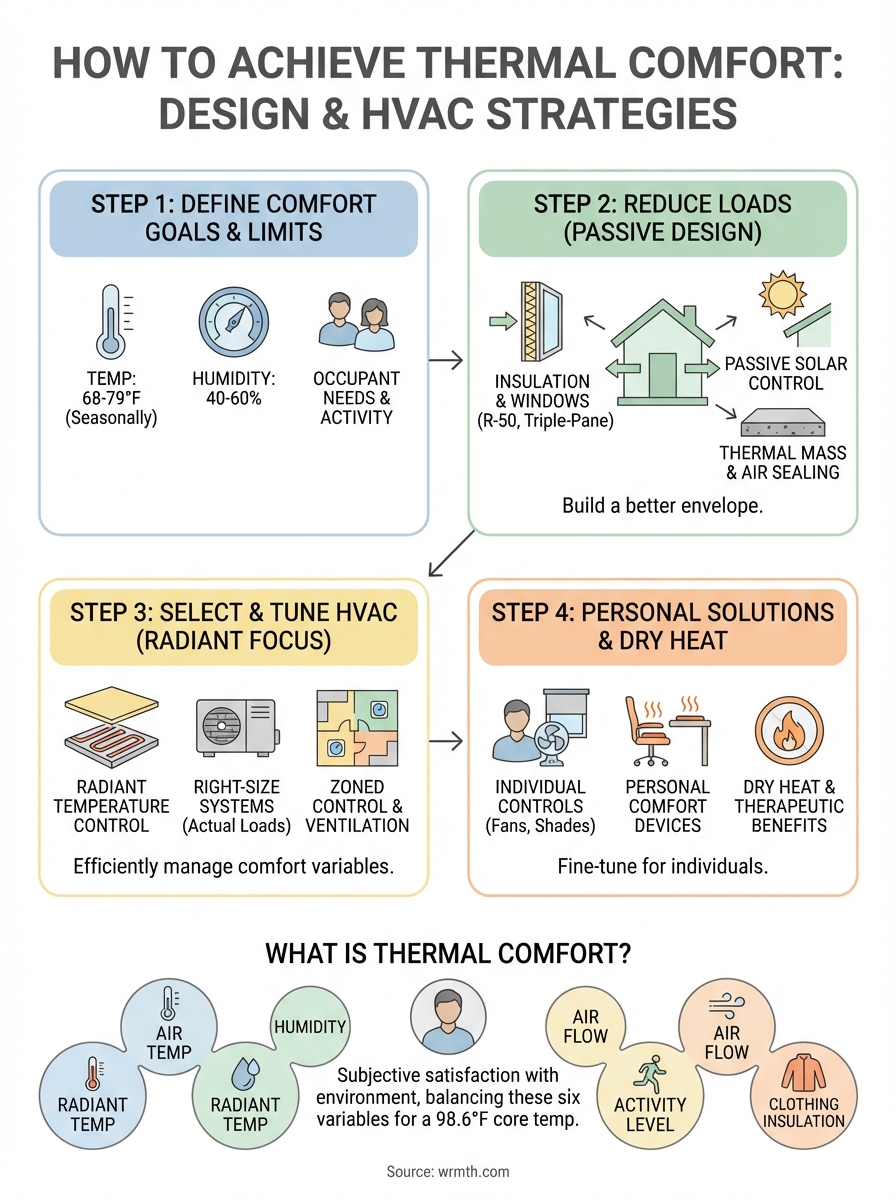
This guide walks you through four proven steps to achieve thermal comfort. First you'll set clear comfort goals for your space. Then you'll learn building design strategies that reduce heating and cooling loads naturally. Next comes selecting and tuning HVAC systems that work with your design. Finally you'll discover personal comfort solutions that let people adjust their own environment. These steps help you create spaces where people feel good and stay productive instead of constantly fighting over temperature controls.
What is thermal comfort
Thermal comfort describes the condition when you feel satisfied with the temperature around you. Your body constantly works to maintain a core temperature of 98.6 degrees Fahrenheit (37 degrees Celsius). When your environment makes this regulation easy, you feel comfortable. When it forces your body to work hard to stay warm or cool, you experience discomfort.
Understanding thermal comfort means recognizing that it's subjective and personal to each individual.
The six variables that control comfort
Six distinct factors determine whether you feel comfortable in any space. Air temperature gets most attention but accounts for only part of your comfort experience. Radiant temperature from surrounding surfaces like walls, windows, and ceilings affects how warm or cool you feel. You might sit in 72-degree air but feel cold because nearby windows radiate chill.
The other four variables play equally important roles. Humidity impacts how efficiently your body cools itself through perspiration. Air velocity affects evaporative cooling and whether you feel drafts. Your metabolic rate changes based on activity level, from sitting still to walking around. Finally, clothing insulation traps air next to your skin and alters how much heat your body retains or releases.
Scientists measure thermal comfort using predictive mean vote (PMV) which combines all six variables into one number. A PMV of zero indicates neutral comfort while positive numbers mean too warm and negative numbers mean too cold. Understanding how to achieve thermal comfort requires you to control these six factors together rather than adjusting only your thermostat. When you balance all variables, you create spaces where the majority of occupants feel satisfied with conditions.
Step 1. Define comfort goals and limits
Before you select equipment or design systems, establish clear comfort targets for your space. Most buildings fail at comfort because designers skip this crucial step and jump straight to picking HVAC units. You need specific numbers that define acceptable temperature, humidity, and air velocity ranges. These targets guide every decision you make afterward, from insulation levels to vent placement.
Start by identifying your space type and occupant needs. Office workers performing sedentary tasks require different conditions than warehouse staff moving boxes. Consider who uses the space, what activities happen there, and how long people stay. Document these factors because they directly influence your comfort criteria. Understanding your occupants helps you learn how to achieve thermal comfort that actually works for real people in your specific building.
Set temperature and humidity ranges
Establish acceptable operative temperature ranges based on season and activity level. Winter comfort typically falls between 68 and 75 degrees Fahrenheit while summer comfort ranges from 73 to 79 degrees. These ranges come from ASHRAE Standard 55, which bases recommendations on extensive research into human thermal response.
Humidity matters just as much as temperature. Target relative humidity between 40 and 60 percent for most indoor spaces. Below 40 percent causes dry skin and respiratory irritation. Above 60 percent enables mold growth and makes moderate temperatures feel sticky. Your HVAC system must control both variables simultaneously to maintain comfort.
Define specific numeric ranges rather than vague goals like "keep it comfortable" to give your design team clear targets.
Account for seasonal variations
Adjust your temperature targets by season instead of maintaining the same setpoint year-round. People naturally adapt to outdoor conditions and dress differently in January versus July. Winter clothing provides more insulation so occupants feel comfortable at slightly lower indoor temperatures. Summer clothing offers less insulation and people expect slightly warmer conditions.
Build these seasonal adjustments into your control strategy from the start. Shifting your heating setpoint down by two degrees in winter and your cooling setpoint up by two degrees in summer reduces energy costs by 15 to 20 percent. This approach matches occupant expectations while cutting utility bills.
Step 2. Reduce loads with smart building design
Smart building design cuts your heating and cooling needs before you spend money on expensive mechanical systems. Your building envelope acts as the first line of defense against outdoor temperature extremes. Walls, windows, roofs, and foundations either trap conditioned air inside or let it escape. When you improve these passive elements, you reduce the workload on HVAC equipment and create more stable indoor conditions that make learning how to achieve thermal comfort much easier.
Passive design strategies work continuously without consuming energy. Well-insulated walls maintain consistent surface temperatures that prevent occupants from feeling radiant chill near exterior walls in winter or radiant heat in summer. Proper window placement captures winter sun while blocking summer heat. These approaches reduce temperature swings and create comfortable conditions naturally. Start your design process by maximizing passive strategies before adding active mechanical systems.
Start with the building envelope
Insulation levels determine how quickly heat moves through your building envelope. Specify R-50 walls, R-67 roofs, and R-13 windows for cold climate construction. These values exceed minimum code requirements but pay for themselves through reduced operating costs. Your roof loses the most heat because warm air rises, making it your highest priority for insulation upgrades.
Window selection impacts comfort more than any other envelope component. Triple-pane windows with low-emissivity coatings block heat transfer while allowing daylight through. Install higher-performance windows on cold exposures like north-facing walls. Standard double-pane units work fine on warm south-facing walls that benefit from solar heat gain. This strategic approach optimizes both cost and performance.
Air sealing prevents conditioned air from escaping through cracks and gaps. Target Passive House standards of 0.6 air changes per hour at 50 pascals pressure. Apply continuous air barriers during construction and seal penetrations for pipes, wires, and ducts. Test your building with a blower door to verify airtightness before occupancy.
Reducing air leakage by half typically cuts heating and cooling costs by 20 to 30 percent while improving comfort.
Design for passive solar control
Orient your building to capture winter sun and block summer heat. South-facing windows maximize solar heat gain during cold months when the sun travels low across the southern sky. Size these windows carefully because excessive glass creates glare and overheating problems. Calculate the optimal window-to-wall ratio for your climate using solar angle data.
External shading devices block summer sun before it enters your building. Horizontal overhangs work perfectly for south-facing windows because they shade high summer sun while allowing low winter sun to penetrate. Install operable exterior blinds or shutters on east and west exposures where morning and afternoon sun creates the worst glare and heat gain problems.
Add thermal mass strategically
Thermal mass materials absorb excess heat during the day and release it slowly at night. Concrete floors and interior masonry walls stabilize indoor temperatures by dampening temperature swings. Place thermal mass where direct sunlight hits it during winter so it stores solar heat for evening release. Keep thermal mass inside your insulation envelope so stored heat benefits occupants rather than escaping outdoors.
Step 3. Select and tune HVAC and ventilation
Your passive design strategies reduce loads but mechanical systems still handle remaining heating, cooling, and ventilation needs. Traditional HVAC systems focus exclusively on air temperature while ignoring the other five variables that affect comfort. This narrow approach leads to oversized equipment, wasted energy, and complaints from occupants. Radiant temperature from surfaces accounts for more than 50 percent of how comfortable you feel, yet most systems do nothing to control it. Select equipment that addresses all comfort variables rather than just conditioning air.
Match your system selection to the comfort goals you defined in step one. Calculate actual heating and cooling loads based on your improved envelope rather than using generic rules of thumb. Systems sized correctly for your reduced loads cost less to install and operate more efficiently than oversized equipment. Right-sized systems run longer cycles that maintain steady conditions instead of short-cycling between temperature extremes that cause discomfort.
Focus on radiant temperature control
Install radiant heating and cooling systems that regulate surface temperatures directly. Radiant floors, ceilings, or panels embedded in walls warm or cool surrounding surfaces to maintain comfortable mean radiant temperature. Water circulating through these systems operates at moderate temperatures between 65 and 85 degrees Fahrenheit, requiring far less energy than forced air systems. Radiant systems work silently without creating drafts or distributing dust.
Combine radiant systems with dedicated outdoor air systems (DOAS) that handle ventilation separately. DOAS units condition fresh air to remove humidity and filter particles while your radiant system manages temperature. This approach lets each system optimize for its specific task. You control both air quality and thermal comfort without compromise.
Radiant systems paired with DOAS provide superior comfort at 20 to 30 percent lower energy costs compared to conventional forced air systems.
Size systems for actual loads
Calculate heating and cooling loads using Manual J procedures after finalizing your building envelope design. Input your actual insulation values, window specifications, air tightness results, and occupancy patterns. Generic sizing charts overestimate loads by 50 to 100 percent because they assume code-minimum construction. Your improved envelope requires much smaller equipment capacity.
Select equipment rated for your calculated loads rather than rounding up to the next standard size. Slightly undersized equipment runs longer and maintains more stable conditions than oversized units that satisfy loads quickly then shut down. Modern variable-speed systems adjust output continuously and handle minor undersizing without problem. Verify your load calculations with energy modeling software that simulates annual performance under actual weather conditions.
Implement zoned control
Divide your building into zones based on orientation, usage, and occupancy patterns. South-facing zones need different control than north-facing spaces because solar heat gain varies dramatically. Offices with computer equipment generate more internal heat than storage areas. Create separate control zones for each distinct thermal environment.
Install programmable thermostats or building automation systems that adjust setpoints by schedule and occupancy. Unoccupied spaces can drift several degrees from comfort range to save energy without affecting anyone. Occupancy sensors trigger ventilation and temperature control only when people occupy a zone. This targeted approach to learning how to achieve thermal comfort reduces energy waste while maintaining satisfaction in occupied areas.
Configure ventilation systems to deliver fresh air based on occupancy rather than running continuously. Demand-controlled ventilation uses CO2 sensors to modulate outdoor air intake proportional to the number of occupants present. This strategy cuts ventilation energy costs by 40 to 60 percent while maintaining excellent indoor air quality.
Step 4. Use personal comfort solutions and dry heat
Central HVAC systems cannot satisfy everyone simultaneously because people have different comfort preferences based on metabolism, clothing, and activity level. Personal comfort solutions let occupants fine-tune their immediate environment without forcing everyone to endure the same conditions. These targeted approaches eliminate thermostat wars and reduce energy consumption by allowing central systems to operate in wider temperature ranges.
Provide individual control options
Give occupants tools to adjust their personal microclimate within the larger space. Desk fans provide adjustable airflow that helps people cool down without lowering the entire building temperature. Operable window shades let individuals block radiant heat from sunlight or allow it in for warmth. Install task lighting that generates localized heat for people who run cold.
Consider advanced personal comfort devices for spaces where temperature conflicts persist. Heated desk pads, seat cushions, and small radiant panels deliver warmth directly to individual occupants rather than heating the entire room. These devices consume minimal energy, typically 50 to 150 watts, compared to space heaters that draw 1500 watts. Personal cooling vests and portable air circulators serve people who run warm. Send an message to ask Wrmth Corp. about solutions for indoor radiant heating they are not listed on the website.
Personal comfort devices reduce HVAC energy costs by 10 to 20 percent while increasing occupant satisfaction scores.
Apply dry heat for therapeutic benefits
Dry heat sources provide comfort advantages beyond basic temperature control. Radiant heating panels and heated surfaces transfer warmth directly to your body without relying on heated air circulation. This approach maintains comfortable humidity levels while delivering consistent warmth that penetrates muscles and joints. People with chronic pain conditions report significant relief from dry heat exposure.
Install heated furniture or dedicated warming zones in spaces where people sit for extended periods. Conference rooms, reading areas, and outdoor spaces benefit from localized dry heat that keeps occupants comfortable without overheating the entire area. Understanding how to achieve thermal comfort includes recognizing that targeted heat delivery often works better than whole-space conditioning.
Design for lasting comfort
Learning how to achieve thermal comfort requires you to think holistically about your space. Start with clear comfort goals that define acceptable temperature, humidity, and airflow ranges for your occupants. Passive design strategies reduce your mechanical system loads by 40 to 60 percent before you spend money on equipment. Right-sized HVAC systems paired with radiant temperature control deliver superior comfort at lower operating costs than traditional forced air approaches.
Personal comfort solutions complete your thermal strategy by addressing individual preferences that central systems cannot satisfy. Occupants need options to fine-tune their environment, from desk fans to heated surfaces. For outdoor spaces, heated furniture extends your usable season by providing direct warmth where traditional patio heaters fail. Explore heated outdoor furniture that delivers therapeutic dry heat while you relax on decks and patios. Combining these four steps creates environments where people feel comfortable and productive rather than constantly fighting temperature controls.